

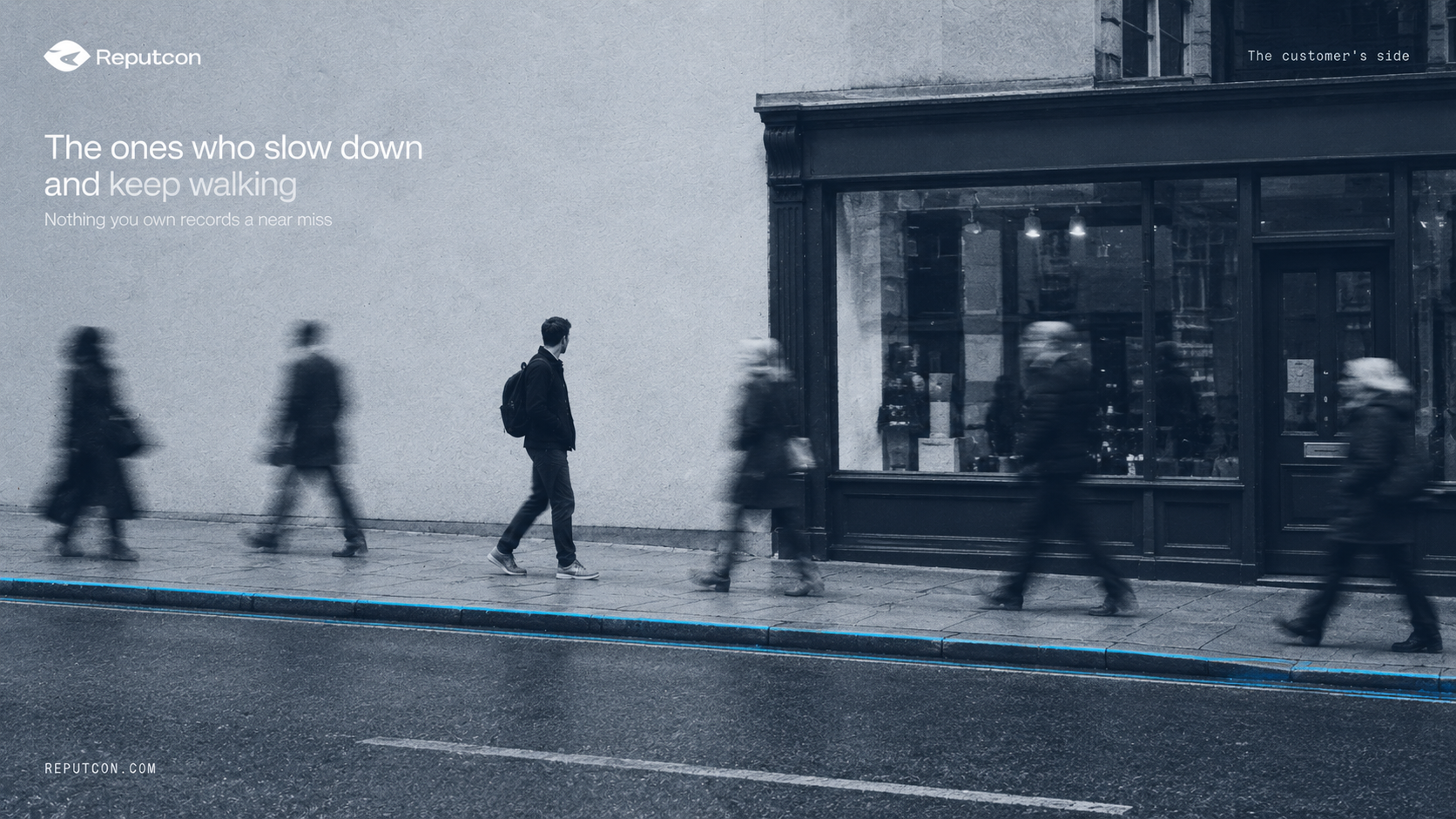
I Counted the People Who Walked Past and Didn't Come In
I sat outside a cafe on Gloucester Road in April with a laptop I did not open. It was one of those bright cold afternoons where sitting outside is a slightly stupid decision, and I made it anyway.
I meant to work. Instead I started counting people.
Over about forty minutes, somewhere around three hundred people walked past. Eleven went in. I want to be honest about that straight away: I was not doing science. I lost count twice, I have no idea whether that Thursday was typical, and one stretch of one street on one afternoon proves nothing about anybody's business, including that one.
But something in it stuck with me, and it was not the eleven.
The ones who nearly came in
Of those three hundred, six or seven did something different. They broke stride.
You can see it happening. Someone is walking at pace, then they slow slightly, their head turns, they read the A board or look through the glass for a second, and then they resume their original speed and keep going. The whole thing takes about two seconds and they probably would not remember doing it an hour later.
One couple actually stopped. Properly stopped, stood there, one of them said something to the other, and then they walked on and went into the place about forty metres further down.
Those are the most valuable people who went past that cafe all afternoon, and the business has absolutely no record that any of them existed.
Every system you own only counts the yes
Think about what a small business actually measures. The till counts sales. The diary counts bookings. The stock system counts what left the shelf. Your card terminal, your rota, your accounts, all of it is a record of things that happened.
None of it records a near miss. There is no line anywhere in your business for the person who was one small thing away from coming in and then did not.
That is a strange gap, because those people are the cheapest customers you will ever get. Someone who slowed down has already done the hard part. They are on your street, at the right time, in the right mood, interested enough to turn their head. You do not need to advertise to them, discount to them or persuade them of anything. They were already most of the way there.
Everyone else in that three hundred was never going to come in that day. Those six or seven were live.
Why did they carry on
I do not know, and that is the frustrating part of this. I could not stop them and ask, and if I had, most of them could not have told me. It was a two second decision made below the level of conscious thought.
I can guess, and a guess is all it is. The board faced up the hill, so anybody walking down it saw the back of it. There was a queue of four visible through the window at half past three on a Thursday, which is a longer wait than the time of day suggests you should have. Nobody behind the counter looked up. The door was shut, which it has every right to be in April, but a shut door on a cafe reads as closed at a glance and a propped one does not.
Any one of those might be the reason. All of them might be irrelevant. That is exactly why guessing is not good enough.
Twenty minutes and a tally
If you have a shop, a salon, a cafe, anywhere people walk past, this is worth doing once and it costs you nothing but the time.
Stand across the road at your busiest hour and count three numbers for twenty minutes. How many people went past. How many slowed or looked. How many came in. Write them down. Do it again on a different day at the same time, because one sample of anything is a story rather than a number.
Then change exactly one thing and count again. Turn the board round. Prop the door. Put the lights on at the back of the room, which makes a shop look open in a way nothing else does. Clear the window of the boxes that have lived there since February. One change at a time, or you will never know which one did it.
You will probably find that the gap between people who slowed and people who entered is far larger than you expected, and that closing even a small part of it is worth more than anything you could do with an advert.
The number nobody has
The reason almost nobody knows their own version of this is not that owners are incurious. It is that nothing they own collects it. Every tool a small business buys is built to record the transaction, and the transaction is the end of the story.
The more useful information is nearly always the thing that did not happen. The booking that was not made. The regular who has not been in for five weeks. The person who broke stride and carried on. None of it shows up in your takings, and all of it is telling you something.
Most of that gap cannot be closed with a clipboard, which is the honest limit of the tally I have just described. The rest of it is what I am building Reputcon to watch, and the waitlist is at reputcon.com.