

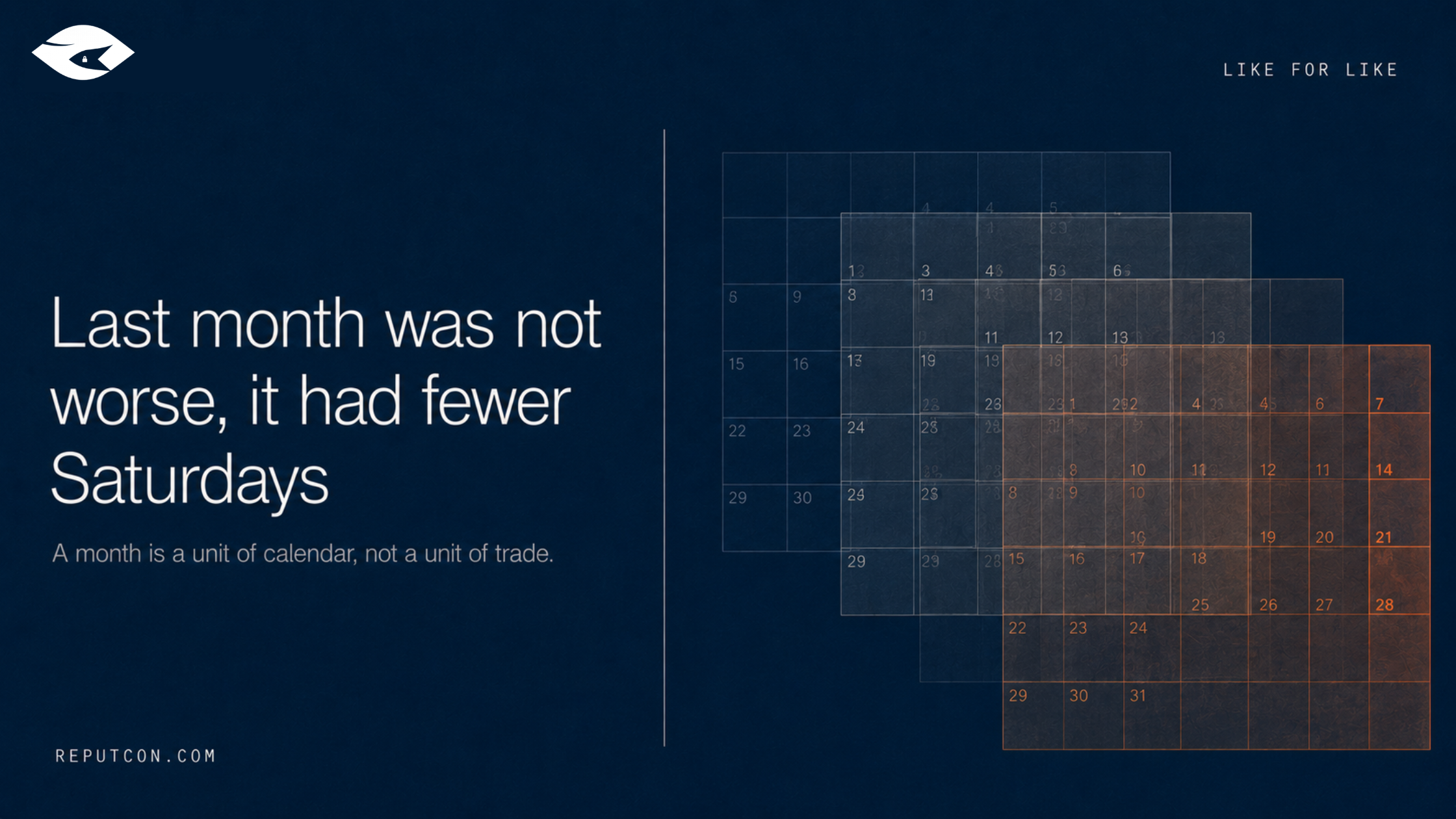
Last month was not worse, it had fewer Saturdays
Somewhere around the fifth of the month you sit down and compare last month to the one before it. Down four percent. You start hunting for the reason.
There may not be one. One month had five Saturdays. The other had four.
A month is not a unit of trade
A month is a unit of calendar, and the calendar is lumpy in ways that hit some businesses very hard.
Any given month contains either four or five of each weekday. If Saturday is your biggest day, and it is for most places that serve the public, then a four Saturday month has twenty percent fewer Saturdays than a five Saturday one. Say a Saturday is worth roughly three Tuesdays to you. That single missing day can move the whole month by more than the percentage you are currently staring at and worrying about.
Nothing went wrong. The shape of the month changed.
The other things that make two months incomparable
Bank holidays, which help some businesses enormously and shut others for a day.
School terms, which for anywhere near a school, a park, or a commuter route are effectively two different businesses running alternately.
Weather, which is not a mood, it is a demand variable. A wet fortnight is a real event that shows up in your takings and never shows up in your explanation.
A single unrepeatable day. One large booking, one road closure, one street event. If last month had one and this month did not, you are not comparing performance. You are comparing luck.
Why this costs money
Because you act on it.
Trade looks down, so you change something. You cut the Thursday shift, or you drop a price, or you have an uncomfortable word with someone who did nothing wrong. You have now made a real change to the business on the strength of a difference that the calendar created and would have reversed by itself next month.
The opposite is worse and quieter. Trade looks flat, so you conclude everything is fine. But this month had an extra Saturday and a bank holiday, which means that underneath the flat number something has actually got worse, and it is now hidden by a tailwind that is not coming back.
That is the expensive one, because you will not find it for months.
Compare like for like
You do not need software to fix this. You need three habits.
Count the trading days, not the calendar days. How many Saturdays, how many Sundays, how many days you were actually open. Write it next to the total. Two numbers instead of one and the whole thing gets easier to read.
Compare to the same month last year, not to last month. The same month a year ago usually has a similar shape, similar weather and similar school terms. It is a far better mirror than the thirty days that happened to come immediately before.
Keep a one line note of anything unrepeatable, on the day it happens. A road closed. A heatwave. A coach party. Ten seconds at the time saves you inventing a story about it six weeks later, when you will have forgotten and will confidently blame something else.
The point
Most owners are not short of numbers. They are short of context, and a number without context is not information, it is a mood.
Business intelligence sounds like a large phrase for something quite small. Mostly it means knowing whether a number means anything before you spend money reacting to it.
The month was not worse. It was shorter where it counted.