

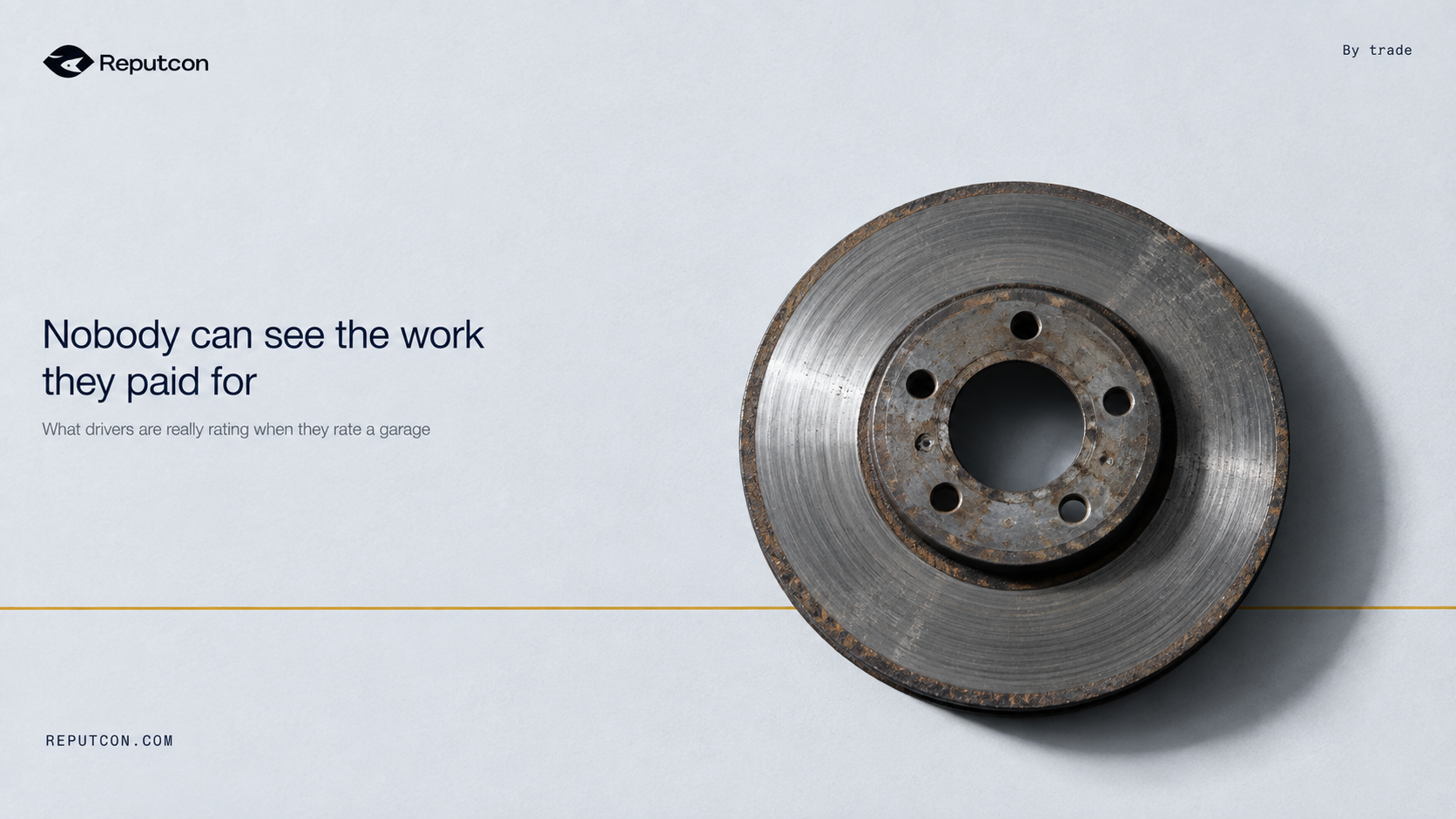
Nobody Reviewing Your Garage Can Judge the Work
A customer collects their car after a brake job. They pay, they drive home, and at no point in that entire transaction do they have any way of knowing whether the discs needed replacing, whether the pads you fitted are decent ones, or whether the work was done properly at all. Unless something goes wrong months later, they will never know.
So when they sit down that evening and leave you three stars, they are not rating the brakes.
What they are actually rating
The phone call. Whether the figure on the invoice matched the figure you said on the phone. Whether anybody rang when the job ran into a second day. Whether the seat was shoved right back and the radio left on a different station. Whether somebody looked up when they walked through the door.
That can grate, especially when you have just spent four hours on something genuinely difficult. But they are not being unreasonable. They are rating the only part of the job they can actually see. Every trade where the work is invisible to the buyer has this problem. Dentists have it, accountants have it, vets have it. It is sharper in a garage because the bill is large, the vocabulary is technical, and the customer is standing at your counter without a car and without any way of arguing.
The gap between the quote and the bill
If I had to name the one thing that turns a perfectly good job into a one star review, it would be this. The bill came in higher than the number on the phone. Not wildly higher. Sometimes sixty pounds higher. The extra work was needed and you could prove it. It does not matter. What people react to is the surprise, not the amount.
I should be honest about where that comes from. I have read a lot of garage reviews while building this, and it is the pattern I keep seeing. I have not counted them, so treat it as an impression rather than a figure.
The fix is boring and it works. Before the car goes up, agree a ceiling out loud. If it comes to more than this, I will ring you before I touch anything. Then actually ring, even when it is forty pounds over and you know full well they will say yes. The call takes a minute and it removes the most reliable way a good job becomes a bad review.
Show them the part
Keep the old one. The split boot, the corroded pipe, the pads worn down to the backing plate, in a box on the counter, handed over. Take a photo on your phone before you start and send it while they are still at work. It is not theatre. It is the only evidence that customer will ever have that the work needed doing at all.
The other half of this matters more, and almost nobody bothers with it. Tell them what they do not need. The advisory on the tyres, you have a few thousand miles left in those, leave them until spring. That one sentence buys more trust than any amount of good work, because it visibly costs you money to say it. Somebody who has heard you turn work down once will believe you the next time you say something is urgent.
The MOT conversation
A fail, an advisory, and a thing that will want doing before winter are three completely different things, and most drivers hear all three as the same thing, which is money. Separate them out loud, in that order, and write them on the invoice in plain English rather than in test manual language.
People will forgive a six hundred pound bill they understood. They will not forgive a two hundred pound one they did not.
Find out which jobs bring you reviews
Here is something worth an hour of a quiet afternoon. Pull up your last thirty reviews and write next to each one what the customer actually came in for. MOT, clutch, diagnostic, aircon regas, tyres, bodywork.
I cannot tell you what you will find, because it differs from garage to garage and I would only be guessing. What I can tell you is that almost no garage has ever looked, and the answer is rarely the job you would have picked. Once you know which work produces reviews and which produces silence, you know which counter conversation is the one worth changing.
And when somebody is clearly pleased, ask them. On the day, at the counter, while the relief of having the car back is still there. Ask them to mention what they came in for, because clutch on a 2014 Focus is a sentence another driver will one day type into Google. Do not write it for them, do not offer them anything for it, and do not ask only the ones you expect to be kind. Just ask, and ask everybody.
Working out which jobs bring the reviews is one of the things Reputcon does on its own, and the waitlist is at reputcon.com.