

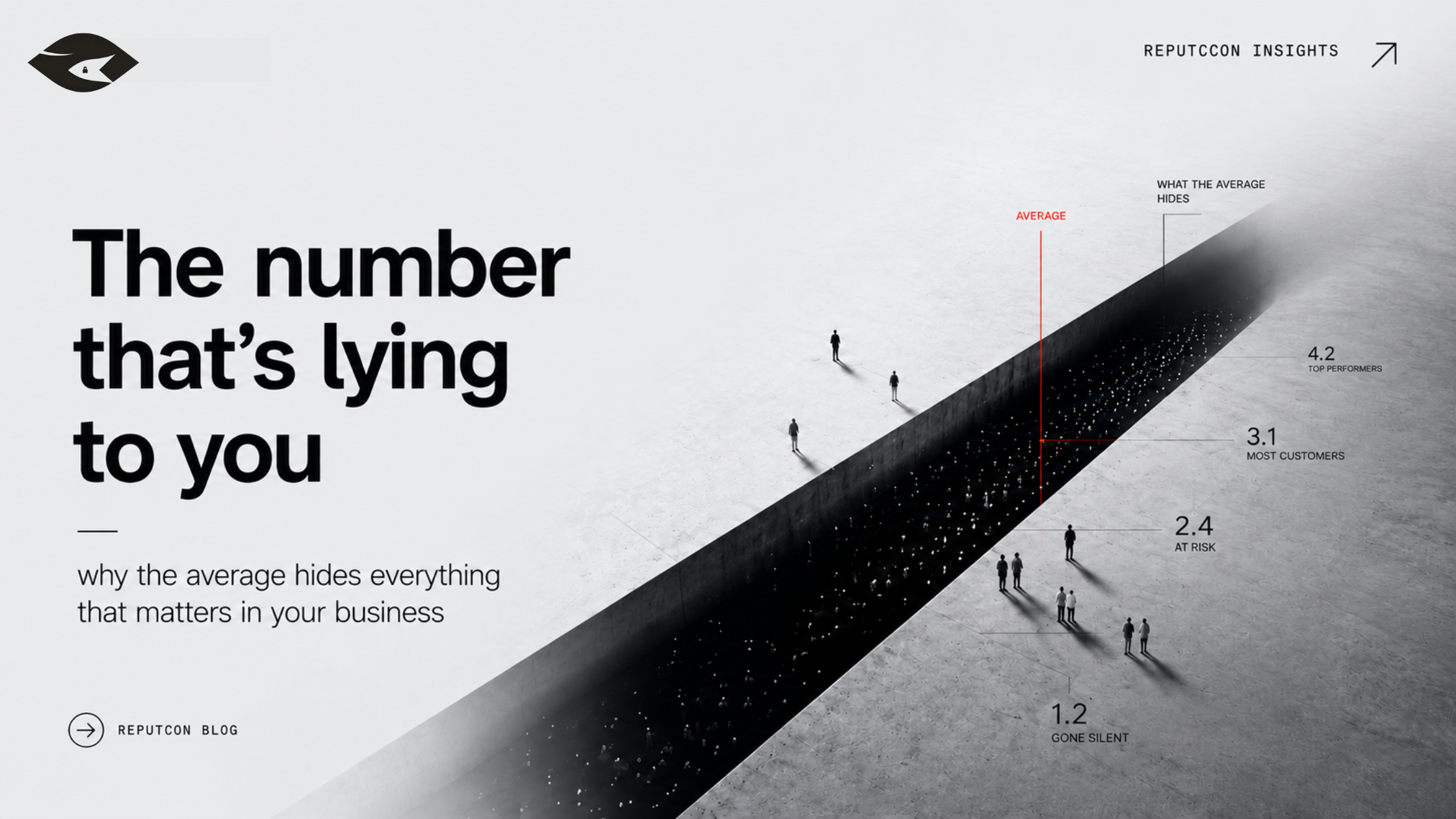
The most dangerous number in your business is the average
The most dangerous number in your business is the average
A statistician drowns crossing a river that is, on average, three feet deep. It's an old joke, but it's the most useful thing anyone will ever tell you about running a business, so sit with it a second. The river averaged waist-height. It was also nine feet deep in the middle. The average was technically correct and it got him killed.
You are doing this. Right now, today, with almost every number you look at. And it feels responsible, because averages sound like data and data sounds like you're being a serious grown-up about your business. But the average is where information goes to hide.
Here's what I mean in the actual world you work in.
Say your average spend per customer is £24. Fine number. Feels precise. Now, that £24 could mean everyone who walks in spends roughly twenty-four quid, a tidy predictable business. Or it could mean half your customers spend £8 and the other half spend £40, which is a completely different business that happens to produce the same average. Same £24, two totally different situations, and only one number on your screen. You cannot tell which world you're in by looking at the average. The average has actively hidden the only thing worth knowing: that you might have two kinds of customer, and you should probably treat them differently, price for them differently, maybe chase more of the £40 lot and gently stop bending over backwards for the £8 lot.
The average smoothed all of that into a single comfortable lie.
Take waiting times, if you're a restaurant or a clinic or anywhere people queue. "Average wait is twelve minutes." Sounds fine. But nobody experiences the average. They experience their wait. And if most people wait five minutes but one table in six waits half an hour, that twelve-minute average looks healthy while a steady stream of furious people walk out the door swearing never to return. The average is fine. The business is quietly on fire. The number designed to reassure you is the exact number stopping you from seeing the problem.
This is the trap. Averages are calming. That's their whole danger. A single tidy figure feels like control, and the messier truth underneath, the spread, the extremes, the two-humped shape of who your customers actually are, is where every real decision lives. Owners reach for the average precisely because it's soothing, and then wonder why acting on it never changes anything.
So what do you do instead, without becoming a spreadsheet goblin about it.
You ask two better questions of every number you look at. First: what's the spread. Not "what's the average wait" but "what's my longest wait, and how often does it happen." Not "what's my average spend" but "what does my biggest spender look like and what does my smallest look like." The extremes are where the money and the problems both hide. The middle is just the part that's already fine.
Second, and this is the one that changes businesses: split the number in two and see if it tells a different story. Weekday customers versus weekend. New faces versus regulars. The stuff you sell at full price versus the stuff that only moves on discount. Almost every average, the moment you cut it down the middle, falls apart into two honest halves that each tell you to do something specific. "My average is fine" becomes "my weekends are carrying my weekdays and I've been pretending otherwise for a year."
You don't need software for this. You don't need a dashboard or a data analyst or a course. You need to stop trusting the single tidy number and start being suspicious of it. Every time someone hands you an average, or you calculate one to feel better, ask what it's hiding. Because it is hiding something. That's the one thing averages reliably do.
The owner who looks fine on average is often the owner in the most trouble, because the average is the last number to move and the first one to lie. The river was three feet deep. Look at the middle before you wade in.