

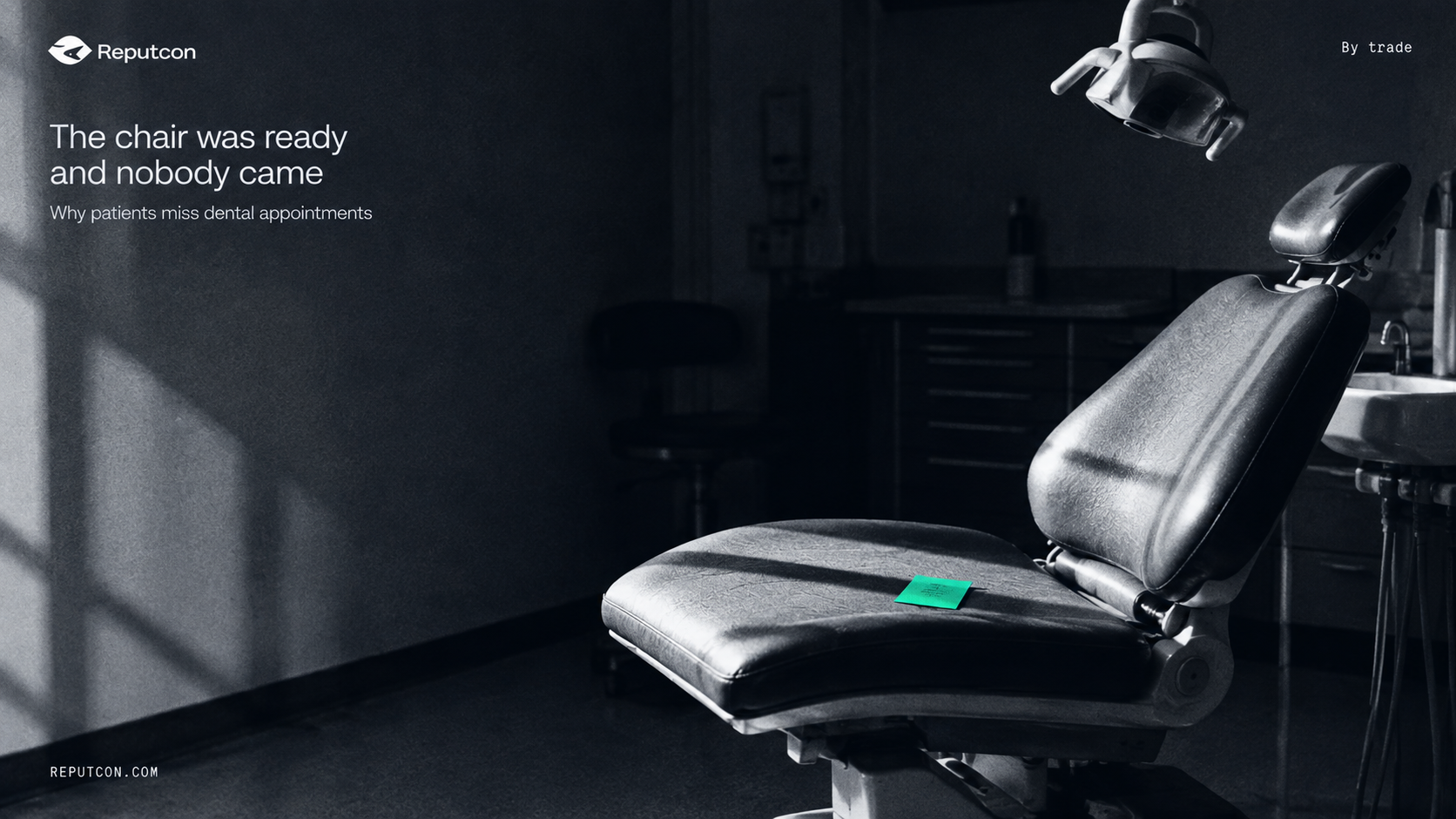
Why Patients Miss Dental Appointments, and Why Reminders Rarely Fix It
Ask a practice manager why patients miss appointments and the answer comes back almost before the question is finished. They forget.
So the fix is reminders. A text a week before, another the day before, perhaps a phone call for the longer treatments. Most practices already do all of that, and most practices still have a chair sitting empty on a Tuesday morning, with a nurse, a dentist and a fully prepared surgery waiting for somebody who is not coming.
Reminders are not the problem. They are a good fix for one cause, and forgetting is only one of several.
The reasons that are not forgetting
Nerves come first, and dentistry carries more of this than almost any other trade. A patient who dreads an appointment does not forget it. They think about it all week. A reminder two days out gives them two clear days to talk themselves out of it, and plenty do, often without ringing, because ringing to cancel means explaining why.
Then cost. Someone unsure what the next visit will cost, and privately suspecting it will be a lot, will quietly avoid finding out. Not a rational decision. A very human one.
Then time. A routine check booked at the end of the last one was made six months ago by someone with a different job, a different childcare arrangement and a different week. The appointment was real when it was made. Somewhere in between it stopped fitting their life, and nobody told the practice.
And yes, some people simply forget. But if forgetting were the main cause, a good reminder system would make the problem disappear. It is worth asking honestly whether that matches what happens in your own diary.
Missed appointments are a dataset
The useful shift is to stop treating each missed appointment as a one-off annoyance and start treating the whole list as information.
Pull the last six months of failed appointments. For each one, note how far ahead it was booked, the day and time, whether the patient was new or established, what the treatment was, and whether they had missed before.
We cannot tell you what your list will show. It differs from practice to practice, and anything more specific would be a guess. What it very rarely is, though, is random. Gaps tend to cluster around something: appointments booked a long way ahead, one particular slot, one kind of treatment, or a small group of patients responsible for a surprising share of the total. Once the cluster is visible, you know which cause you are actually dealing with, and each one needs a different fix.
Matching the fix to the cause
If long lead times are the problem, stop booking routine recalls six months out. Send the recall invitation a few weeks before it is due and let the patient pick a time that suits the life they have now, not the one they had in March.
If it is nerves, change what the reminder says. Not just the date and time, but what will happen, roughly how long it takes, and that they can ask to stop at any point. A reminder that answers the fear is a very different message from one that simply announces the date of it.
If it is cost, give the likely figure before they come in, as clearly as you can. Uncertainty keeps more people away than the real number would.
If it is a small group of repeat missers, handle them as a group. A phone call rather than a text, a confirmation step, a policy explained plainly and applied the same way to everyone.
Whatever the cause, keep a short-notice list of patients happy to come in at a day's warning, so a cancellation becomes a filled slot rather than a lost one.
What an empty chair actually costs
An empty chair costs exactly the same to run as a full one. The surgery is lit, the nurse is paid, the dentist is there.
As an illustration only, with a round number rather than yours: lose two slots a week at £80 each and that is more than £8,000 a year of fully staffed time producing nothing. And that is before counting the patient whose treatment is now weeks later than it should have been, which is its own problem.
None of that is fixed by a better-worded text alone. It is fixed by knowing which kind of missed appointment you actually have.
Reading patterns like this out of the information a business already holds is what Reputcon is being built for, and the waitlist is open on the site.