

You are probably charging about 15% too little
You are probably charging about 15% too little
Ask a local business owner why they charge what they charge and you'll get some version of the same answer. "It's about what everyone round here charges." "It felt right." "That's what I started at."
Nobody says "I worked it out." Almost nobody has.
So let's actually work it out, because the numbers here are genuinely startling and most people have never seen them laid out.
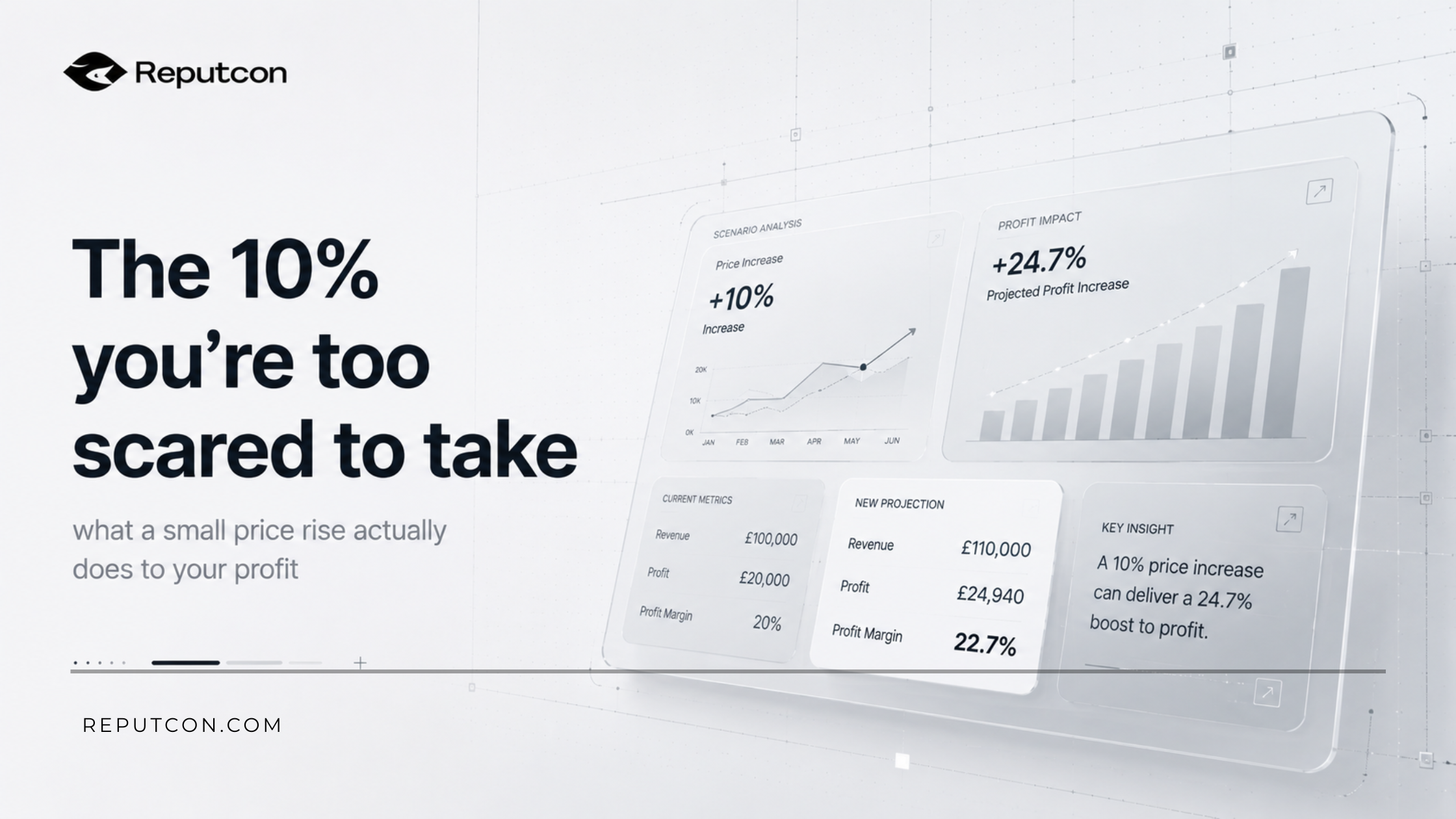
Say you turn over £200,000 a year and your costs are £170,000. Rent, stock, wages, insurance, the van, the accountant, all of it. You take home £30,000. That's a normal-shaped small business and a fairly grim year.
Now put your prices up 10%. Not 50%. Ten percent. If every customer stays, you turn over £220,000, your costs barely move because you're serving the same number of people with the same rent and the same staff, and your profit goes from £30,000 to £50,000.
Read that again. A 10% price rise, which most customers will not consciously register, produced a 67% increase in what you take home. That's the whole thing. That's the lever. There is no marketing campaign, no new sign, no social media push that does that, and you can do it on a Tuesday afternoon for free.
"But I'd lose customers." Right, let's do that maths too, because this is where it gets interesting.
At those numbers, you could lose roughly a fifth of your customers after a 10% rise and still be no worse off in profit. A fifth. Gone. Same money in your pocket, while doing meaningfully less work, using less stock, with more room in the diary. In reality you will not lose anything like a fifth. Most price rises of that size lose you a handful of people, and I'll tell you now exactly who those people are.
They're your worst customers.
The ones who leave over 10% are the ones who were only ever there for the price. They haggle. They query the invoice. They're the ones who take up an hour of your time for the smallest job, cancel at short notice, and never refer anyone because the only thing they'd have to say about you is that you were cheap. Meanwhile the customer who values you, who's been coming for four years, who tells their neighbours about you, that person does not leave over 10%. They probably don't even notice. And if they do, they assume it's inflation, because everything else in their life went up too.
This is the part owners get emotionally stuck on. You picture the loyal regular's face when they see the new price. But the loyal regular is precisely the one who isn't going anywhere. You've built your entire pricing strategy around not upsetting the people who were going to leave anyway.
There's a second thing going on, quieter and harder to admit. Price is information. When you're the cheapest option, people don't conclude you're a bargain, they conclude something's off. Cheap dentists worry people. Cheap builders really worry people. Being the cheapest in your area isn't a competitive position, it's a signal, and often not the one you want.
I'd also gently point out that your costs have gone up every single year, relentlessly, and there's a decent chance your prices haven't kept pace. If you last raised prices three years ago, you didn't hold steady. You gave yourself a substantial pay cut in slow motion and didn't notice because the number on the invoice looked the same.
So, practically. Don't do a big dramatic announcement. Don't write a paragraph apologising, because apologising tells everyone it's a big deal when it isn't. Just change the price. New customers pay the new price from today, and that's the end of it. If you feel you owe your regulars something, give them a heads up a few weeks out, framed once and without hand-wringing.
Pick 10% if you're nervous. Pick 15% if you're honest with yourself about how long it's been. Then hold your nerve for two months, because the fear peaks in week one and the sky does not fall.
The single most useful thing you can do is sit down tonight, take your actual turnover and your actual costs, and run the same three lines I ran above with your own numbers. It takes five minutes. Most owners have never once seen what a 10% rise does to their own profit, and once you see it you can't unsee it.