

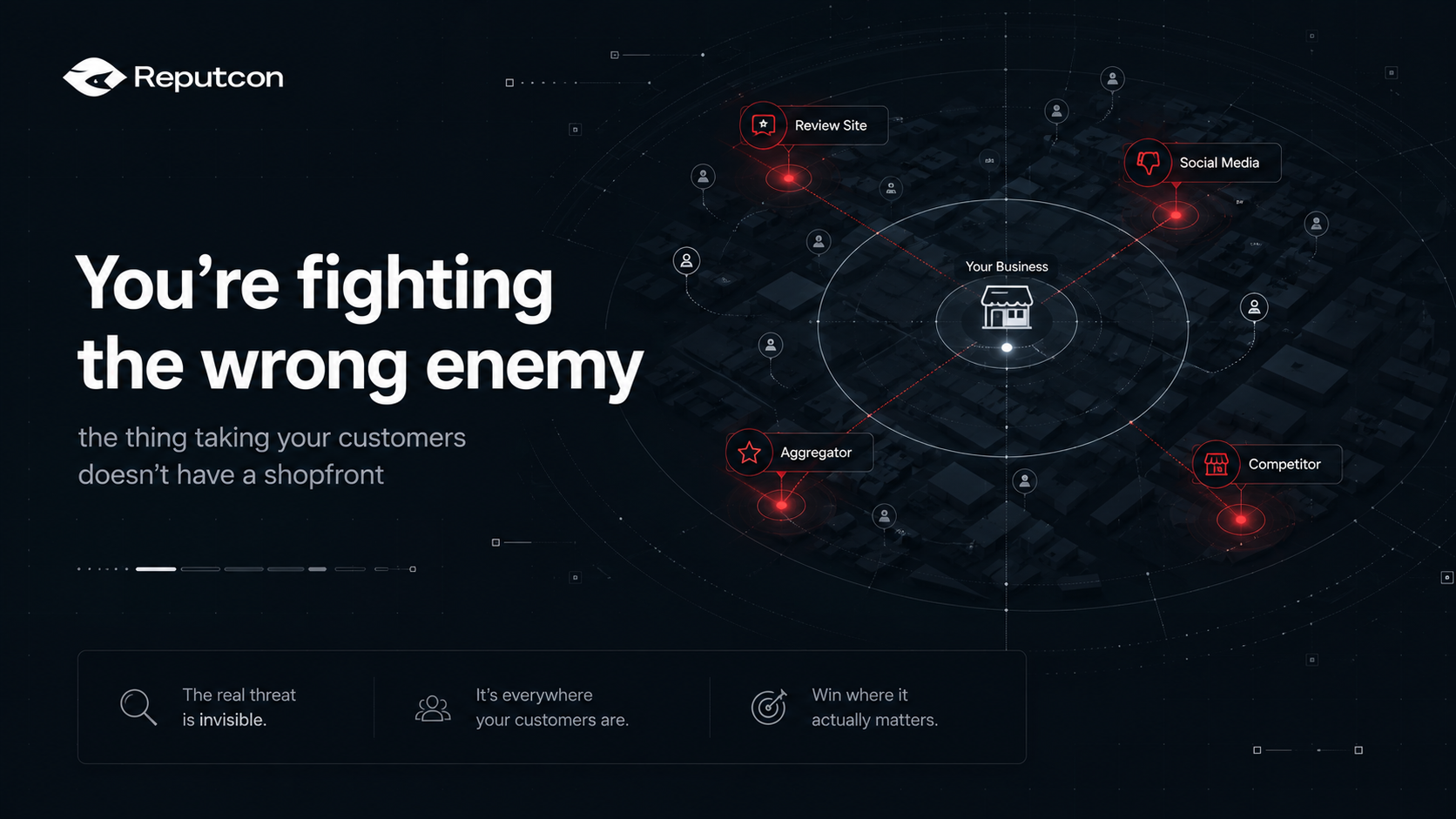
Your biggest competitor isn’t a business
Your biggest competitor isn’t a business
There’s a barber in my area who could tell you everything about the shop that opened two doors down. Their prices, their opening hours, the fact that they do the hot-towel thing, the Instagram account with the moody lighting. He watches them like a hawk. He’s convinced they’re the reason his chairs sit empty on a Wednesday.
They’re not. The reason his chairs are empty on a Wednesday is a man at home who looked in the mirror, decided he could get another week out of it, and sat back down. That man didn’t go to the shop down the road. He didn’t go anywhere. And that, not the rival with the nice lighting, is where most local businesses quietly bleed out.
We’ve all been trained to think about competition as a fight between businesses. Me versus them. My cafe versus your cafe. It makes for a tidy story and it’s almost entirely wrong. Because when a customer decides what to do with their money and their afternoon, you’re not on a shortlist of two shops. You’re on a shortlist that includes “not bothering,” “doing it myself,” “putting it off till payday,” and “we’ve already got beans in the cupboard.” Most of the time, one of those wins. Not your rival. Nothing wins.
Think about who really beats you.
The dentist doesn’t lose the patient to the dentist across town. They lose to “my tooth’s not that bad, I’ll leave it another few months.” The restaurant on a rainy Tuesday isn’t losing the table to the restaurant next door, it’s losing it to a sofa, a duvet, and something already in the freezer. The gym’s real enemy has never been the other gym, it’s Monday. Always Monday. The plumber loses the job to a bloke on YouTube and a £6 washer. In every one of these the alternative the customer actually picked wasn’t a competitor at all. It was inaction, delay, or make-do.
This matters because it completely changes what you should be doing with your time.
If you believe your enemy is the shop down the road, you spend your energy on the arms race. Match their price. Copy their offer. Repaint the sign because theirs looks fresher. You end up in a shoving match with another struggling business over the same slice of already-decided customers, and the main result is you both make less money.
But if you understand that your real competitor is a customer talking themselves out of it, the whole job changes. Now the question isn’t “how do I look better than them.” It’s “how do I get someone off the fence.” Those are not the same problem and they don’t have the same answers.
Getting someone off the fence is mostly about friction and permission. Friction is every small reason to not bother right now: I don’t know if they’re open, I’d have to call, I don’t know what it costs, I’m not sure they do that, parking’s a nightmare, I’ll do it later. Every one of those is a place where the customer quietly chooses nothing. You can’t out-friction inertia by being 5% cheaper. You beat it by making the yes stupidly easy. Show the price before they have to ask. Answer the phone, or make it so they never need to. Put the boring practical facts, hours, parking, do-you-take-walk-ins, right where a hesitating person can see them, because a hesitating person will take any excuse to close the tab.
Permission is the other half, and it’s softer. People need a reason that today is the day. Not a discount, necessarily. A nudge. The reminder that it’s been six months. The “we’ve got Thursday free this week.” The gentle poke that turns “I really should” into “fine, booked.” Half your lost business is people who were going to become customers eventually and just never got the little shove.
Here’s the uncomfortable part for the barber watching the shop down the road. If that new place vanished overnight, his Wednesdays would still be empty. The man in the mirror still wouldn’t come in. He was never choosing between two barbers. He was choosing between getting a haircut and not.
So stop scouting the competition for a week. Genuinely, put it down. Instead, go find the last ten people who nearly became customers and didn’t. The enquiry that went cold. The quote you sent that got a “thanks, will let you know.” The regular you haven’t seen in three months. That’s your real market, sitting right there, and not one of them picked your rival. They picked nothing. Nothing is beatable. Your rival’s hot towels are not really your problem.