

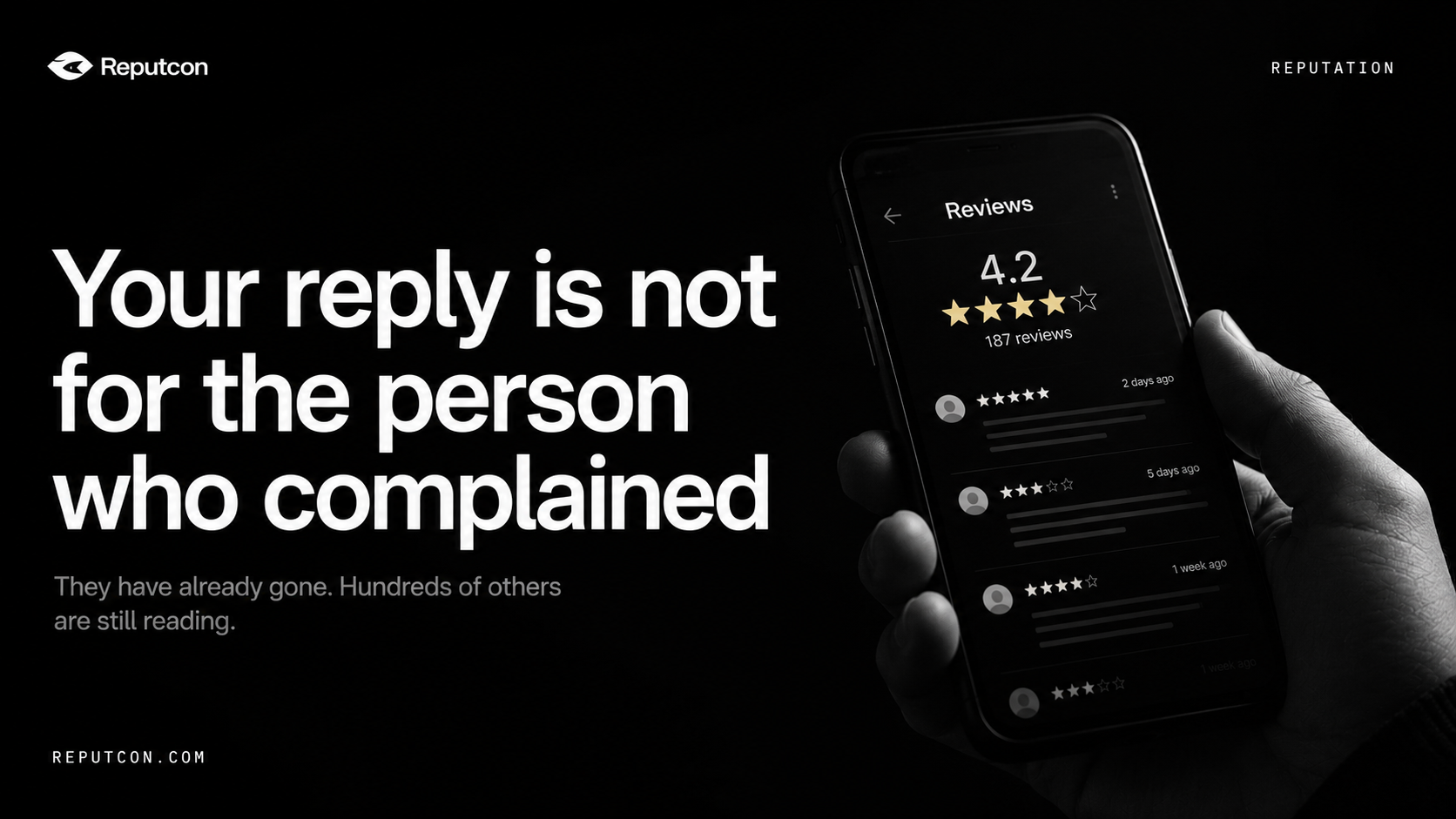
Your reply is not for the person who complained
A one-star review lands on a Monday morning. The owner reads it, feels the sting, and writes back. The reply is careful and defensive. It explains that the kitchen was short-staffed, that the booking was for 8:15 and not 8:00, that the customer had in fact been offered a replacement dish.
Every word of it is true. It is also aimed at exactly one person, and that person is never coming back.
Meanwhile, roughly four hundred people will read that exchange over the next year while deciding where to spend forty pounds on a Friday night. They are the real audience. Almost nobody writes for them.
The reply is a shop window, not a court case
Once you accept who is actually reading, the job changes completely.
You are not trying to win the argument. You are not trying to change the reviewer's mind, because the reviewer has moved on and will almost certainly never read your response. You are demonstrating, to a stranger who has never met you, how your business behaves when something goes wrong.
That is genuinely useful information for them. Everybody has had a bad meal somewhere. What people are actually trying to work out is whether you are the sort of place that fixes it or the sort of place that argues.
A defensive reply answers that question in the worst possible way, and it answers it four hundred times.
What a stranger takes from each reply
Read your last few responses as if you had never heard of your business.
"We're sorry you feel that way" reads as a brush-off. It concedes nothing and commits to nothing.
"As I already explained to you at the time" reads as an argument continuing in public, and the reader has no idea who is right.
"Thank you for the feedback" attached to a detailed complaint reads as though nobody actually read it.
Now compare: "You're right, the wait was too long that night. We were short in the kitchen and we didn't manage it well. We've changed how we stagger Friday bookings since." A stranger learns that you listen, that you are honest, and that something actually changed. They learn nothing at all about who was right.
The pattern matters more than the reply
Here is the part most owners miss. Individual replies matter less than what the sequence of them says about you.
Someone scrolling your reviews is doing pattern recognition, whether or not they would describe it that way. Ten replies that all open with the same phrase read as automated, and automated reading is worse than no reply. Replies only on the five-star reviews read as selective. A gap of eight months followed by a flurry reads as damage control.
Consistency is the signal. Reply to the good ones briefly and the difficult ones properly, at roughly the same pace, all year.
What to actually do this week
Read your last ten replies as a stranger would, in order. Ask what someone learns about your business from the sequence rather than from any single one.
Answer the complaint's substance, not its tone. If someone is rude but their point about the wait is fair, address the wait.
Say what changed. Not "we take feedback seriously" but the actual thing you did differently. This is the single highest-value sentence you can write, and it is the one most often left out.
Never explain that the customer was wrong, even when they were. The reader cannot verify it and will not try.
Keep it short. Three sentences beats a paragraph, every time.
The uncomfortable bit
Most businesses are writing to an audience of one, on a page read by hundreds, and judging their success by whether they felt vindicated afterwards.
The complainer is gone. The four hundred are still deciding.